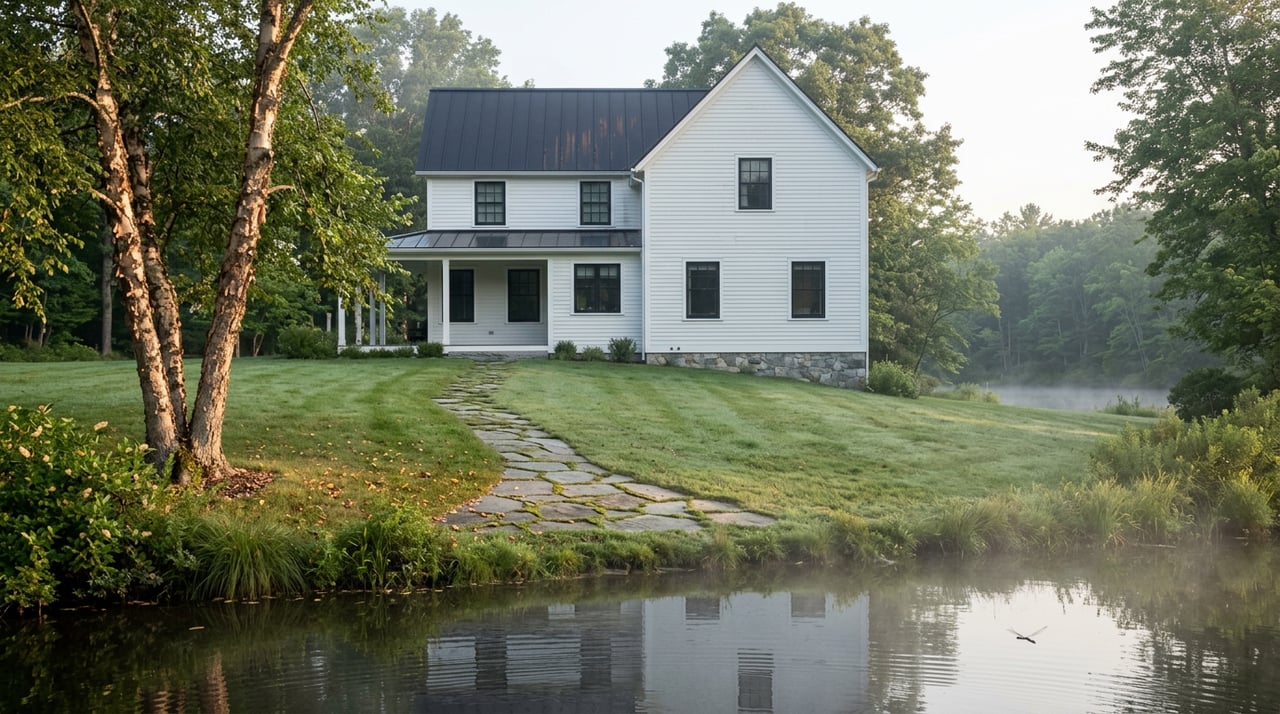
A three-bedroom camp on Rock Pond and a newly built home on Cobbetts Pond can sell for wildly different prices per square foot, and the size of the lake explains almost none of it. Buyers comparing Windham to other southern New Hampshire towns tend to treat "waterfront" as a single line item: pay more, get a view. The actual math is stranger than that, and one piece of it changed for the worse for buyers less than two years ago.
Start with the part that catches people off guard at the closing table, because it's the one a median-price search will never surface.
The Buyer, Not the Seller, Now Pays for the Septic Sign-Off
If you're buying a developed property on Cobbetts Pond, Canobie Lake, or one of Windham's smaller ponds, and any part of the septic system sits within 250 feet of the water's edge, New Hampshire law requires a licensed septic system evaluator to inspect that system before the property can transfer. That much hasn't changed in decades. What changed is who pays for it and who's on the hook if it fails.
Under RSA 485-A:39, effective September 1, 2024, that evaluation is now the buyer's responsibility and the buyer's expense, not the seller's. Before that date, the seller had to commission a site assessment ahead of listing. Now the obligation, the cost, and the timeline all sit on the buyer's side of the table. A buyer can accept a seller's existing evaluation, but only if it was completed within the prior 180 days and formally accepted in writing. If the evaluator finds signs of failure, the buyer signs off on notifying the state and the local health officer, then has 180 days after closing to replace the system and file proof of the new approval.
That's a meaningful shift in leverage. A buyer who assumed the seller had already handled septic due diligence, the way sellers used to, can walk into a purchase and sale agreement not realizing the evaluator call is theirs to make and theirs to fund. The Union Leader covered the change when it took effect, noting that the new law places the primary burden on the buyer, not the seller, and that a failing system doesn't stop a sale but does become the buyer's problem to fix on a clock.
Windham has several lakes and ponds within reach of its town center, which means this rule touches a real share of local inventory, not a rare edge case.
Windham's Lakes Don't Price the Same Way
Not all of the town's lakes carry the same weight in a sale, and the differences aren't about acreage.
| Lake | Approximate size | Swimming allowed |
|---|---|---|
| Cobbetts Pond | Roughly 300 acres | Yes, public town beach with lifeguard |
| Canobie Lake | Roughly 370 acres | No |
| Shadow Lake | ~35 acres | Varies by shore |
| Rock Pond | ~34 acres | Varies by shore |
| Moeckel Pond | ~37 acres | Varies by shore |
| Mitchell Pond | ~14 acres | Varies by shore |
Canobie Lake is the larger of the two big lakes, but Cobbetts Pond has consistently priced higher on a per-foot basis, and the reason isn't the water itself. Cobbetts is a full recreational lake that allows motorboats and jet skis and has a supervised public beach on its west shore, complete with summer boat parades and fireworks. Canobie does not permit swimming. A buyer comparing the two lakes on size alone would expect the opposite pricing pattern. What they're actually paying for on Cobbetts is usage rights, not water volume.
A Second Tax Bill Waits at the Shoreline
Homes around Cobbetts Pond fall inside the Cobbett's Pond Village District, a quasi-governmental body that levies its own assessment on top of Windham's regular municipal tax rate. The district's money goes toward maintaining the dam and funding water quality initiatives on the lake. It's a separate line most buyers don't think to ask about until they see it on a tax bill after closing, and it's not something that shows up when you're scanning a listing sheet or a portal's tax estimate.
Windham's own 2025 municipal tax rate, set through the state's annual review process, was $14.15 per $1,000 of assessed value. That figure is the baseline every Windham property pays. The Village District assessment sits on top of it for shoreline parcels, which means two homes with identical assessed values, one on the lake and one three streets back, will not carry the same total tax bill.
The Old Footprint Is Worth More Than the Old House
Here's where the math gets counterintuitive. Today's shoreland setback rules push new construction back from the water's edge farther than older camps were ever required to sit. But if a buyer purchases one of those older cottages, the one sitting on a footprint grandfathered from before the current rules, and rebuilds on that same footprint, the new home can inherit the old one's closer-to-water position. A brand new house built from scratch on a lot without that grandfathered history has to meet today's setback line. A rebuild on a legacy footprint doesn't. That gap in allowed proximity to the water is often the real value in an unremarkable old camp on the right lot, not the structure sitting on it.
New construction on the lake still needs an approved septic design and a year-round occupancy permit from the Town of Windham before anyone can live there full time, regardless of where the footprint sits.
How real this gets in practice shows up in the town's own records. Windham's Conservation Commission spent part of its March 12, 2026 meeting on a case matching this exact profile: a proposed home on a pre-existing, nonconforming 8,688 square foot lot, in a zone that normally requires 50,000 square feet, with discussion of where the well head sits relative to the flood plain and a septic system that would share a leach field with the neighboring property under a 75-foot setback rule. That's the level of diligence a small, older, water-adjacent lot actually requires, whether or not the buyer's plan is a full rebuild.
What the Median Price Actually Hides
Pull three measurements of Windham home values from 2026 and you'll get three different numbers, and the spread itself is informative. One tracker, measuring closed sales over the trailing twelve months, put Windham's median single-family price at $750,000 as of July 2026, based on 199 residential sales in that window. A separate index that estimates value across the entire housing stock in real time put the town's average at $810,830 as of the end of June 2026. A third source, tracking a single month of actual closed sales, showed a $848,450 median in June 2026 alone, with 76 homes changing hands that month.
None of those three numbers describes the same thing. One is a trailing twelve month median of closed sales. One is a real-time estimated average across every home in town, sold or not. One is a single month's median of what actually closed. None of them isolate waterfront parcels from inland ones, and none of them include the Village District assessment, the buyer's now-mandatory septic evaluator fee, or the setback questions that came up in this year's Conservation Commission review. The median tells you Windham costs more than most of southern New Hampshire. It doesn't tell you which of these costs apply to a specific lake address, or what still shows up after the inspection period closes.
A Few Direct Questions
Does every home in Windham need a septic evaluation before it can sell? No. The RSA 485-A:39 requirement applies specifically to developed waterfront properties where part of the septic system sits within 250 feet of a lake, pond, or river's reference line. A colonial three streets back from Cobbetts Pond with no proximity to water isn't subject to this particular rule, though it will still go through a standard septic inspection as part of normal due diligence.
Should I test well water even if it's not legally required? New Hampshire doesn't mandate well water testing for a home purchase, but the state's granite bedrock is known for naturally occurring arsenic, and a meaningful share of private wells in the region test above the health limit. A standard panel is inexpensive relative to the cost of discovering a problem after you own the well.
Is the Village District tax the same for every Cobbetts Pond owner? It applies to properties within the district's boundaries around the lake, which generally means shoreline and near-shoreline parcels rather than the whole town. Confirm the specific assessment on any lake property you're considering before you finalize your offer.
If you're weighing a lake property against an inland one in Windham, or trying to figure out which of these costs actually apply to a specific address, that's exactly the kind of research worth doing before you write an offer, not after. Connie DiStasio has spent her career in southern New Hampshire real estate answering these questions with straight, researched answers instead of guesses. Let's Connect before your inspection period starts, not during it.