Every Hollis offer packet has two documents most southern New Hampshire buyers don't expect to see until they're already under contract: a well water test and a septic system approval from the state. In most towns, those are afterthoughts. In Hollis, they're the transaction.
That single fact tells you more about how this market prices than any median-list-price headline. Hollis has no public water and no public sewer anywhere in town, and it never did. What looks on Movoto like a rural luxury market is really a permitted-lot market with houses attached, and once you see it that way, the numbers stop feeling contradictory.
The number that doesn't match the story
As of July 2026, the median list price in Hollis sits somewhere between $898,000 and $918,450 depending on which snapshot you pull, with roughly 22 active listings and an average of about 47 days on market. Price per square foot averages $302 to $342. Compare that to Bedford, where the median list runs closer to $1,195,000 but price-per-square-foot pushes higher because the lots are smaller and the houses are newer and denser.
The Hollis median doesn't buy you more house. It buys you more land.
| Price band (July 2026) | What it typically buys in Hollis |
|---|---|
| Under $300K | A two-bedroom unit at Runnells Landing, the 55+ condo community off Silver Lake Road |
| $500K–$700K | An older ranch or Cape on 1 to 2 acres, often with private well and a septic system installed before 1990 |
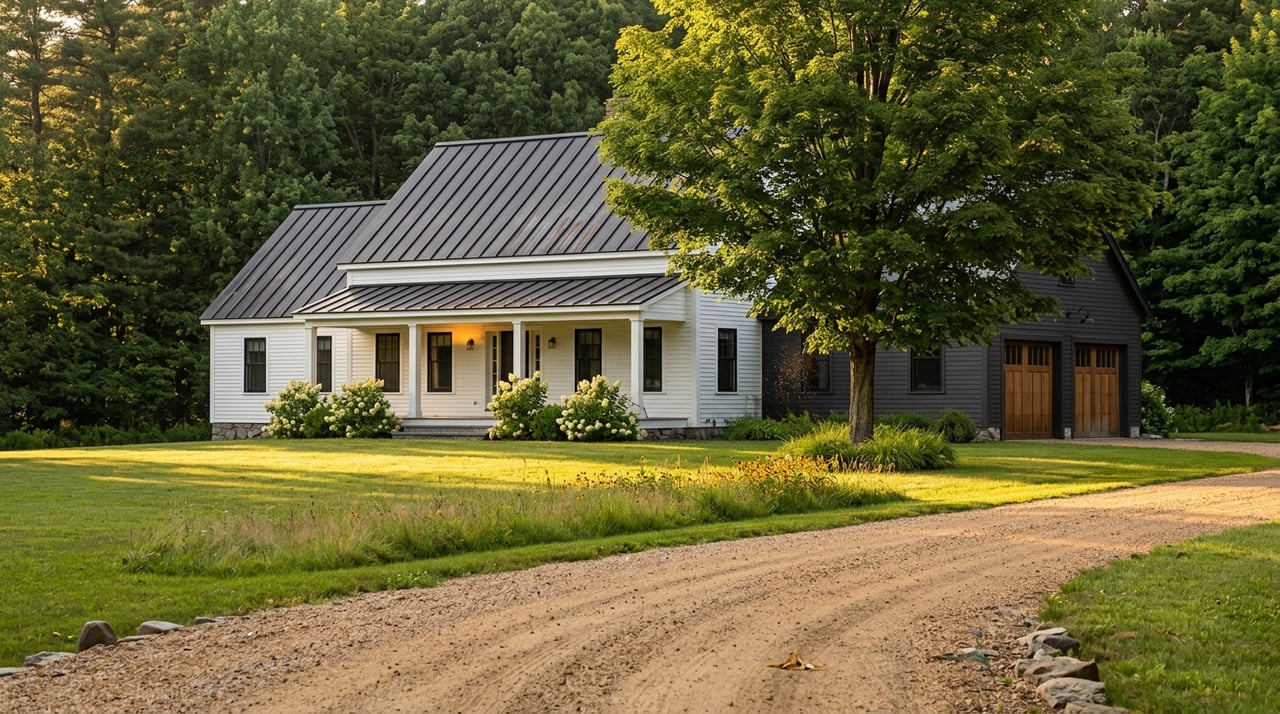
| $800K–$1.1M | A 3,000 to 4,000 sq ft colonial on 2 to 4 acres, updated systems, wooded lot |
| $1.5M+ | An estate, farmhouse, or equestrian property on 5 or more acres, frequently abutting conservation land |
The bifurcation is the point. There is almost no middle. A buyer who wants a 1,800 sq ft starter home on a quarter acre is looking in Nashua or Merrimack, not here, and that is by design.
Why an 80-year-old zoning choice still sets the price
Hollis adopted its residential zoning ordinance early, with minimum lot sizes of two and four acres across most of town, and it deliberately declined to install public sewers or a municipal water supply. That single pair of decisions, made generations ago, is why the housing stock looks the way it does today. Thousands of acres are protected, more than ten miles of roads remain unpaved on purpose, and the Beaver Brook Association alone stewards over 2,200 acres and 35 miles of trails from its headquarters at 117 Ridge Road.
When you can't subdivide below two acres and you can't hook into a sewer main, you don't build starter subdivisions. You build one house at a time on generous lots, and the price floor rises with the cost of land, drilling a well, and permitting a septic system through the New Hampshire Department of Environmental Services. The current Hollis Zoning Ordinance, recodified in May 2025, still identifies the arterial network as NH Routes 111, 111A, 130, 122, 101A, Broad Street, and Depot Road, and the rest of the town flows off those spines onto low-density residential roads.
The land-use pattern isn't a marketing story. It's a rule set. The town's master plan treats rural character as an outcome to protect, and voters have reinforced that through a Conservation Commission, a Historic District Commission, and a Heritage Commission established in 1999.
Working farms are part of that rule set doing its job. Brookdale Fruit Farm supplies regional supermarkets and hosts other growers who come to study its methods, Lull Farm runs a year-round stand, and Begin Family Farm continues to work Hollis's glacial-mineral soils. From a buyer's perspective, that means the fields you can see from a listing photo are unlikely to become a cul-de-sac in five years. The zoning that keeps them working also keeps supply of buildable residential lots tight, which is the other half of the price equation.
The diligence list looks different here
If your last purchase was in a town with municipal utilities, the Hollis diligence sequence will feel unfamiliar. Lead with these items, not with the cosmetic ones:
- Septic record pull. State septic files go back to 1967 and live on the NHDES OneStop portal. Records from 1967 to 1986 are paper only and often held at Hollis Town Hall at 7 Monument Square. Effective February 1, 2026, all new septic submissions must use revised NHDES administrative forms, so if a seller's design is mid-approval, confirm which version was filed.
- Septic capacity versus bedroom count. A three-bedroom design does not support a five-bedroom renovation, no matter what the floor plan says. This is the single most common surprise for buyers moving up from a sewered town.
- Well water testing. Standard NH panels cover arsenic, radon in water, uranium, manganese, and coliform bacteria. Southern New Hampshire bedrock produces enough arsenic and radon hits that a clean result is worth having in writing before closing, not after.
- Setback verification for expansions. Accessory structures over 250 square feet or 12 feet tall must meet the same setbacks as principal buildings under the current ordinance. If a listing photo shows a large detached barn or a future ADU opportunity, verify the setback math before you underwrite the value.
- Backland lot status. Hollis explicitly permits "backland lots" with reduced frontage but larger minimum size, served by a private driveway. These are common in the higher price bands and carry real questions about shared road maintenance and plowing.
- Unpaved road frontage. With more than ten miles of dirt roads preserved by town policy, some of the most desirable addresses are on gravel. That is a lifestyle choice, and it affects everything from delivery access to how you spec a driveway.
None of this makes Hollis a difficult market. It makes it a specific one. A buyer's agent who runs the same checklist here that they'd run in Manchester is going to miss things.
Where the 2026 market is actually soft
The southern New Hampshire read for spring and early summer 2026 is that homes above $1 million are sitting longer, and Hollis is the clearest example of it. With average days on market around 47 as of early July 2026 and roughly 22 active listings, the story isn't oversupply. It's price discipline. A well-prepared home under $900,000 in the Hollis-Brookline school district still moves quickly. A $1.5M-plus estate that leans on last year's comps is watching the calendar.
For a seller, that means the pricing conversation matters more than it did in 2022 or 2023, and staging the land, the barn, the trails behind the house, and the abutting conservation acreage matters at least as much as staging the kitchen. For a buyer, it means the leverage that didn't exist for three years is quietly available again at the top of the market, provided you can move confidently through well and septic diligence.
The buyer who wins in Hollis in 2026 is the one who understands they are buying a permitted lot with a house on it, priced against a fixed and shrinking supply of land the town has spent 80 years protecting.
A few questions worth answering
Is Hollis really all private wells and septic, with no exceptions? Substantially yes for residential properties. There is no municipal sewer or public water supply serving Hollis homes. Individual wells and NHDES-approved septic systems are the standard, which is why those two inspections belong at the front of your offer, not the back.
Why is price-per-square-foot lower in Hollis than in Bedford if the median price is high? Because Hollis buyers are paying for acreage. Two- and four-acre minimums push land value up as a share of the total, so a 3,500 sq ft house on 3 acres reads as "cheaper per foot" than a similar house on a half-acre in a denser town, even when the total price is comparable.
Does the 55+ condo market at Runnells Landing follow the same rules? No. That community operates on shared systems and a fundamentally different price band, which is why sub-$300K activity there sits in a category of its own and doesn't move with the single-family land market. Two very different products, one town.
What about new construction? Small cul-de-sac developments like Cook Custom Homes' Ladd Lane in south Hollis show up periodically, but they're custom builds on individual lots, not tract subdivisions. Expect a build timeline that includes state septic approval and well drilling, not just framing.
If you're weighing Hollis against Amherst, Bedford, or Merrimack and want a clear read on what your specific budget buys once land, well, and septic are factored in, that's exactly the conversation Connie DiStasio is set up to have. Let's Connect.